Category Archives: France

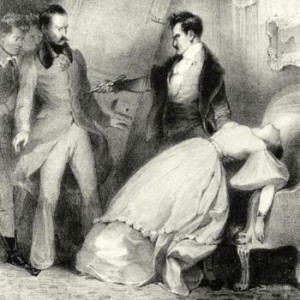
Episode of the play of Dumas “Antony”

“She resisted me, I murdered her!”

–The last scene of “Antony”

Antony, hero of Dumas, was compared with “The Sorrows of Young Werther” 1 (1774) of Goethe and Saint-Preux, “Julie,or the New Heloise “(1761) by Rousseau from the point of view of the triangular relationship with a married woman; At the point of temperament, he was compared with the hero of “Hernani” (the first performance in 1830) of Hugo and Didier who is also a bastard and the hero of “Marion Delorme” (the first performance in 1831) “Chatterton” (the first performance in 1835) by Vinnie.

Here, look at the place of “Antony” in relation to theories which prepared the French romantic drama like “Conversation on the son Natural ” of Diderot, “Eugénie, drama of five acts in prose with an essay on the serious drama” (First performance 1767) by Beaumarchais, “Racine and Shakespeare” of Stendhal or “Preface to Cromwell” of Hugo.

Diderot and Beaumarchais who followed him, to unload the traditional dichotomy as “tragedy” and “comedy,” proposed to create the intermediate genre that had a close relationship to civil life, and Hugo promoted the theory that particularly abandons the units of Time and place in the three units 2 from the intermediate genre of drama,

Stendhal insisted on the abandonment of the Classical unities, more particularly on the abandonment of the drama in verse, but Hugo did not abandon all the dramas in verse all his life. By the way, since Mérimée, “Cromwell” (England in the 17th century), “Hernani” (Spain in the 16th century), “Marion de Lorme” (France in the 17th century) by Hugo, and “Christine” (Sweden in the 17th century) of Dumas himself, even if they were historical dramas, but they were all written in verse. However, a year before “Hernani”, Dumas, audaciously launched “Henri III and his court” on the stage of the Théâtre Français, as if he had responded to Stendhal’s assertion, because this play was the drama in Prose with the local colors (of the time and the locality).

I now quote the episode that I love the most from “The three Dumas” written by André Maurois. Because there are too many interesting episodes in the life of Alexandre Dumas as a writer, you can not count them all. This episode among others has truly become one of the favorite episodes for me, for the reason that makes me feel the essence of theater.


Antony’s success was deep and lasting. One hundred and thirty performances in Paris. The salons, for the first time, came to the Porte-Saint-Martin. In the provinces, this drama remained the triumph of Marie Dorval. She loved the drama and served it well. One day, at Rouen, an ignorant stage director dropped the curtain on Antony’s stabbing, without waiting for the final reply. Bocage, furious, ran to shut himself up in his box. The public, deprived of the expected and already celebrated denouement, protested loudly.

Dorval, good girl, resumed the pose on the armchair. Bocage refused to reappear on the scene. The audience shouted, “Dorval! Bocage!” and threatened to break the benches. The stage director, terrified by this squall, raised the curtain in the hope that Bocage would yield. The audience gasped. Marie Dorval felt that it was necessary to act. The dead woman sat up, got up, and walked to the footlights. “Gentlemen,” she said, “I resisted him. He murdered me.” Then she made a curtsey and went out, “greeted by a thunder of applause.” Such is the theater. 3
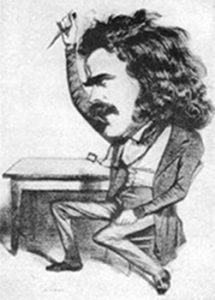

Bocage (1801-1863) caricature

Marie Dorval (1798-1849)
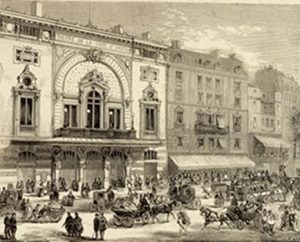

Théâtre de la Porte-Saint-Martin

Notes:

  1. Original German title: Die Leiden des jungen Werthers ↩
  2. unity of action: a play should have one action that it follows, with minimal subplots, unity of time: the action in a play should occur over a period of no more than 24 hours, unity of place: a play should exist in a single physical space and should not attempt to compress geography, nor should the stage represent more than one place ↩
  3. André Maurois, Les Trois Dumas, Hachette, 1957, p.98. translated by me. ↩

On sot-l’y-laisse

Regarding cooking recipes, I recently use many iPhone apps for examining it on the net, so I use it conveniently. As for turkey, I was good at looking up at Cookpad, but because I then in Paris, I made reference to Alexandre Dumas’s ” le Grand Dictionnaire de Cuisine” (Grand Culinary Dictionary). More exactly I opened  PDF file on my iPad. I tried to examine the item of turkey in it. This book was full of ridiculous  (interesting ) stories about gastronomy rather than recipe books, and in the turkey section also. Let me introduce these phrases because it’s fantastic and amusing.


Although the flesh of the turkey, especially cold, is excellent, full of flavor, and preferable to that of chicken, there are gourmets who eat absolutely nothing but so-l’y-laisse, etymology: fool who leaves it. One day Grimod de la Reynière, the uncle of the famous Comte d’Orsay, who for twenty years gave fashion to France and England, one day Grimod de la Reynière being in a financial tour surprised by the night or By bad weather, or by one of those insurmountable obstacles which force an Epicurean to stop at a village inn, ask the host what he can give him for supper. The latter confesses to him with shame and regret that his pantry is completely empty. A great fire shining through the glass panes of a glass door, which is none other than that of the kitchen, attracts the attention of the illustrious gourmand, who sees with astonishment seven turkeys turning to the same spit.

“How dare you tell me that you have nothing to give me for supper,” exclaimed Grimod de la Reynière, “when I see seven splendid turkeys at the same pin, which have reached their degree of cooking?”

“That is true, sir,” replied the host, “but they are restrained by a gentleman of Paris who has arrived before you.”

“And this gentleman is alone?”

” Alone.”

“But is this traveler a giant?”

“No, sir, he is not much bigger than you.”

” Oh! Oh! Tell me the number of this fellow’s room, and I shall be very awkward if he does not give me one of his seven turkeys. “

Grimod de la Reynière was lighted up and led to the traveler’s room, where he found him near a table set up, seated in front of an excellent fire, and sharpening each other two cutting knives.

“By god! I am not mistaken, “cried Grimod de la Reynière,” it is you, my son!”

“Yes, father,” replied the young man, bowing respectfully.

“Is it you who have seven turkeys for your supper?”

“Gentleman,” replied the amiable young man, “I understand that you are painfully affected to see me manifesting sentiments so vulgar, and so little conformable to the distinction of my birth, but I had no choice of food; There was only them in the house.

“By god! I do not reproach you for eating turkey in the absence of poulardes or pheasants; When traveling, we are obliged to eat what we find, but I reproach you for having seven turkeys on your spit only for yourself.

“Sir, I heard always you telling to your friends that there was really nothing more than so-l’y-laisse in the turkey without truffle, then I had seven turkeys put on the spit for fourteen so-l’y-laisse.”

“That seems to me a little expensive for a boy of eighteen, but I can not say that it is unreasonable.” replied his father, paying homage to the intelligence of the young man.

Avignon has always been a city where we have eaten wonderfully, it is an old tradition in the days when Avignon was a pontifical city.

A respectable president of the city court appreciated the qualities of the turkey. He once said: “By my faith, we have just eaten a superb turkey, it was excellent, stuffed with truffles to the beak, tender like a chicken, fat as an ortolan, perfumed like a thrush. We have left only the bones.

“How many were you? ” A curious one.

“We were two, sir!” He replied.

“Two? …”

“Yes. The turkey and me.”

(translated by me)

See the original french version here.

image-138
From the turkey section of Alexandre Dumas’s Great cooking dictionary

While reading such an episode, Dumas’ cooking dictionary eventually did not serve as a recipe for cooking at all, but it may be said that such a thing is also a pleasure of travel.

10th August 2014